

What exactly does it mean a vertical tasting? And no, it is not about tasting wines standing upright, vertically! Vinatis demystifies this professional tasting.

VERTICAL TASTING
Vertical tasting makes you smile, because its name works on the imagination. What is this type of tasting, which is often only available to wine professionals? A vertical tasting is actually a journey through time for the tasters. It consists of tasting the same wine, the same cuvée, in different vintages, as opposed to horizontal tasting which involves the same vintage for all the cuvées. The basic rule is to start with the most recent vintages, i.e. the youngest wines, and continue with the older vintages. It is interesting to carry out this tasting of decreasing vintages with more than five wines and ideally ten.
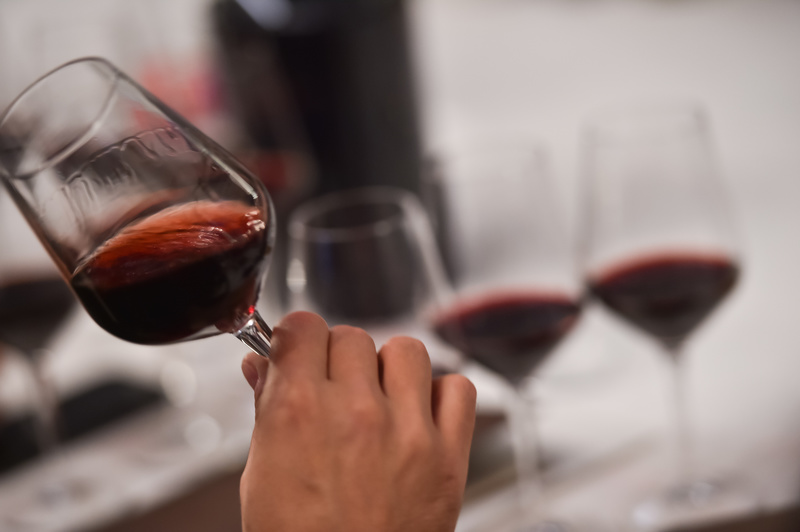
As in any tasting, the four essential steps must be respected:
- The visual analysis
- The olfactory analysis
- The taste analysis
- The summary or conclusion

ADVANTAGES OF VERTICAL TASTING
UNDERSTANDING THE WINEGROWER'S CHOICES
Vertical tasting is also a way of understanding certain choices that the winemaker has made from one vintage to the next. For a vintage marked by heat and sunshine, they may prefer minimal handling of the product, avoiding barrels and preferring stainless steel vats to preserve maximum freshness and fruit. For a cold and rainy vintage, the winemaker will favour a good passage in oak barrels to add structure and complexity to the wine. Perhaps, unlike other vintages, he will even need to add sugar to the must in order to achieve a minimum alcohol content. Again, every year is different and you can taste it in the wine! In the art of tasting, identifying the impact of the weather from one vintage to another is one thing, identifying the precise work of the winemaker is another.
IMAGINING THE EVOLUTION AND AGEING POTENTIAL
In addition to allowing us to understand the impact of the vintage on the product, vertical tasting also allows us to understand the evolution of the same cuvée. Even if it remains a theory, this type of tasting allows one to imagine the ageing potential of a cuvée. Ideally, you should be able to compare two vintages of the same cuvée at different ages, but this is impossible unless you really have a time machine!
UNDERSTANDING THE IMPACT OF THE VINTAGE
Tasting the same wine in different vintages allows us to understand the concrete impact of the vintage on the wine. Indeed, no two years are alike and therefore, no two vintages are alike either! Even if the ten or so selected vintages come from the same estate and the same parcel, their tastes differ, since the impact of the weather is not negligible. A vintage marked by strong heat and sunshine will bring more power and much sweeter grapes. Whereas a vintage characterised by rain and frost will make the wine lighter, less sweet.
DISADVANTAGES OF VERTICAL TASTING
GOOD AND BAD VINTAGES
Neither an advantage nor a disadvantage in itself, vertical tasting allows one to identify "good" and "bad" vintages. When wine professionals use these adjectives, they are referring, among other things, to the concentration of the wines, as well as their ageing potential. A warm, sunny vintage promises a much higher ageing potential than a rainy one.
Knowing how to identify and recognise good and less good vintages also helps to understand the prices of certain bottles. Indeed, the work required as well as the ratio of product quality to quantity directly influence the price of bottles. A vintage that required a lot of work and handling could see its price increase, just as the winemaker could lower his price, aware that his wine cannot be kept for more than 4 or 5 years. A very good year, or an exceptional vintage, will justify a high price. In line with its quality! Complex aromatic palette, concentration, ageing potential, everything is there! The game of supply and demand having begun, don't be surprised to observe much higher prices for vintages said to be exceptional.
A QUESTION OF TASTE AND STYLE
Pour des AOC normalement marqués par la puissance et les tannins, un millésime pluvieux et plus frais donnera des vins moins alcoolisés, plus légers et donc plus accessibles. Cela peut en effet correspondre à certaines personnes qui ne souhaitent pas attendre cinq ou dix ans avant d'apprécier une bouteille. Ou encore à certains palais qui d'ordinaire ne sont pas friands de vins puissants et qui s'orientent habituellement vers des cuvées d'appellations plus septentrionales, pour la fraîcheur du fruit. Le millésime donne son style au vin et nous n'avons pas tous les mêmes goûts !
SUNNY VINTAGE VS RAINY VINTAGE
Vertical tasting has several advantages for professionals, but it has one disadvantage, which can also be called a 'false problem'. In fact, some vintages have much more influence on the wine than others. If, typically, a less glorious vintage, marked by rain and bad weather, is found between two sunny vintages, the wine will seem too light, even bland. In this tasting, this vintage could be at a serious disadvantage qualitatively, as it is compared to other more glorious years. A complicated vintage does not necessarily mean a bad wine. It simply means that it is marked by its year and that the winemaker has had to redouble his work and imagination to create a product worthy of its appellation.
what is a HORIZONTAL wine tasting?
how to identify a good or bad wine list in a restaurant?
which wine goes well with umami flavour?
the 5 great wines of the world that you should taste at least once
domaine chante cigale, a family tradition in the heart of the vineyards of Châteauneuf-du-pape
bOrdeaux wines: 10 iconic châteaux to know
romanée conti in the spotlight
the 2020 vintage en primeur is already very promising

No products available in this selection.
Oops, our stocks are empty at the moment...
Check back later!

Assistance
Follow us
Location
You are on the shop Great Britain


Alcohol abuse is bad for your health, please consume in moderation.
© 2002-2026 VINATIS
